PROCESS
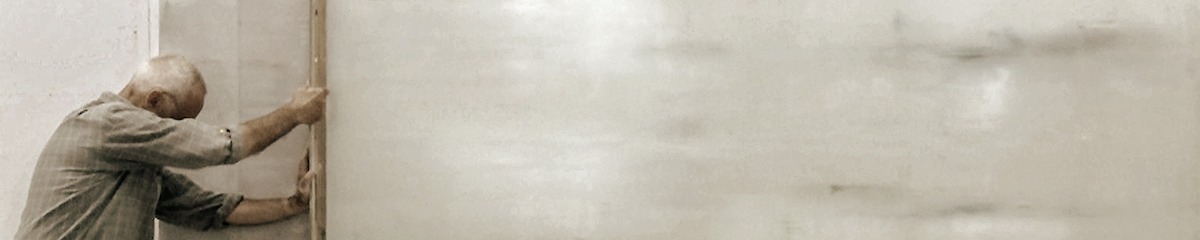
From Gerhard Richter Painting by Corinna Belz, 2011
Artworks have the immanent character of being an act, even if they are carved in stone.
– Theodor Adorno (Philosopher)
For Hegel, the meaning of an act arises only through the act itself. … it’s only through the act itself that you discover retroactively what you really meant to do.
~ Slavoj Žižek (Philosopher)
How do I know what I think until I see what I say?
~ E.M. Forster (Author)
What does it mean to understand film editing as a practised craft? The word ‘editing’ (like ‘building’, ‘writing’, and ‘composition’) is marked by the process-product ambiguity: it refers to both an activity and its result.
Classical theory and textbooks have tended to consider editing in terms of the latter, through analysis of finished films, usually through exemplary film sequences which are broken down shot-by-shot. In particular, this has meant a focus on certain aspects of film form: shot sequencing, rhythm, and narrative function. Analysis of this sort has naturalized editing in terms of story structure, psychology, and emotion, as well as pacing and editing conventions (like continuity). In this context, ‘bad editing’ is identified as poorly paced, overlong, or clumsy storytelling.
This analytical line of thought on editing began with classical film theory written by filmmakers, critics, and psychologists in the early twentieth century. It informs more recent scientific studies in film editing and aligns with current industry norms in scripted film and television
Fundamentally, it emphasizes conceptual design and preparation before shooting, from which an editor inherits authoritative intentions: the script structures the narrative, the shooting process, and the editing. Storyboards and pre-visualization tools are used to plan and order shots (a kind of breakdown classically referred to as ‘decoupage’), or alternately, in lieu of more explicit plans, directors often rely on conventional ‘coverage’ (a set of flexible rules for shooting and editing). Consequently, the editor’s role is to select from different takes, refine the order, duration, and pacing of shots based on performance and technical considerations, and accomplish the plan. Exploration in the edit is used to resolve those problems which arise from inadequacies in planning, but the plan should be all-encompassing. (It’s revealing that in this model, rhythm – regarded as a more ephemeral, less calculable aspect of filmmaking – emerges as an area of skill particular to editing.)
1919
The decoupage, which is the definitive form of the scenario, should indicate in advance, of course, all the shots in their actual order; and it should anticipate their exact length.
~ Henri Diamant-Berger (Filmmaker)
1929
Even while being shot, a film must be thought of already as an editable sequence of separate pieces of celluloid […] the shooting must be related organically to the editing-plan [or ‘filmic analysis’].
~ V. I. Pudovkin (Filmmaker & Theorist)
1958
[In Classical American editing], scenes were broken down just for one purpose, namely, to analyze an episode according to the material or dramatic logic of the scene. It is this logic which conceals the fact of the analysis, the mind of the spectator quite naturally accepting the viewpoints of the director which are justified by the geography of the action or the shifting emphasis of dramatic interest.
~ André Bazin (Theorist)
1979
Editing may be thought of as the coordination of one shot with the next. … most filmmakers plan for the editing phase during the preparation and shooting phase. Shots are taken with an idea of how they will eventually fit together. In fictional filmmaking, scripts and storyboards help plan editing, while documentary filmmakers often shoot with an eye to how the footage will be cut.
~ David Bordwell & Kristin Thompson (Film Academics)
From Interface by Harun Farocki, 1995
While this analytical tradition expands the role of editing in one sense – in the way writing and shooting are influenced by compositional editing concerns – it diminishes the creative possibilities of the editing phase. The extent to which an analytical model governs production is the extent to which planning precludes exploratory and imaginative editing. This principle is vividly reflected in film history folklore regarding the introduction of synchronous sound production (circa 1930): encumbered by new technology, decoupage became more limited, and editing became less flexible, less imaginative.
Of course, editing is not always so governed. In fact, one of the most important considerations for an editor when first considering a project is whether a film is scripted or unscripted. This distinction is more fundamental in the editing room than, for example, the prevailing divide between documentary and fiction (though fiction has been tightly associated with scripted production). Traditions which are less bound by the imperatives of scripting (particularly documentary and experimental film) have consequently relied on the editing stage as an opportunity for formative discovery and development.
1935
[Documentary filmmaking] proceeds from the believe that nothing photographed, or recorded on to celluloid, has meaning until it comes to the cutting-bench; that the primary task of film creation lies in the physical and mental stimuli which can be produced by the factor of editing.
~ Paul Rotha (Filmmaker & Writer)
1980
At the editing table you learn how little plans and intentions have to do with producing pictures. … At the cutting table you discover that the shooting has established new subject matter. At the cutting table a second script is created, and it refers not to intentions, but to actual facts.
~ Harun Farocki (Filmmaker & Writer)
1984
The material we bring to the editing room must be considered as perfectible; we mustn’t remain stuck in the paths made during the shooting.
~ Alain Resnais (Filmmaker)
2015
The point of view of the film emerges from the editing process, and I can’t edit in the abstract. I have to try and figure out what the consequences are of selecting certain sequences, editing them and then ordering them. And it’s only when I do that that the theme or themes begin to emerge.
~ Frederick Wiseman (Filmmaker)
These are traditions oriented to process, mindful of how the activity of editing is approached and organized, with less reverence for initial designs and final forms.
[After working on Apocalypse Now for two years] I sat down and figured out the total number of days that we (the editors) had worked, divided that number by the number of cuts that were in the finished product, and came up with the rate of cuts per editor per day – which turned out to be 1.47! … Apocalypse Now serves to throw into exaggerated relief the fact that editing is not so much a putting together as it is a discovery of a path. … [Our editing days] were spent in activities that, in their various ways, served to clear and illuminate the path ahead of us: screenings, discussions, rewinding, re-screenings, meetings, scheduling, filing trims, note-taking, bookkeeping, and lots of plain deliberative thought.
~ Walter Murch (Editor)
Murch’s exercise illustrates that ‘the cut’ reveals little about the work of editing – what editors actually do. Cuts don’t disclose the extent or quality of the original material or the alternatives that have been considered, nor do they relate to the work an editor does on dialogue, sound, music, visual effects, archival research, or writing. Cuts are the conclusions arrived at through a working process. On their own they are a very limited way of understanding film editing.
In viewing a painting, the observer doesn’t know which stroke was first [‘the order of accumulation’] but wanders (directed by the composition) over the surface.
[…]
Evidence of process has been most clear in the expressionist “line” of Tintoretto, Grunewald, Rembrandt, Courbet, Van Gogh, De Kooning. … Compare to the foregoing the qualities of image, but especially of surfaces, of the paintings of Leonardo, Vermeer, Ingres, Duchamp. Here an attempt has been made to do away, as much as possible, with any evidence of the hand’s activity and the nature and qualities of the materials employed in order to attain the effect of an instantaneous, non-physical image.
~ Michael Snow (Artist & Filmmaker)
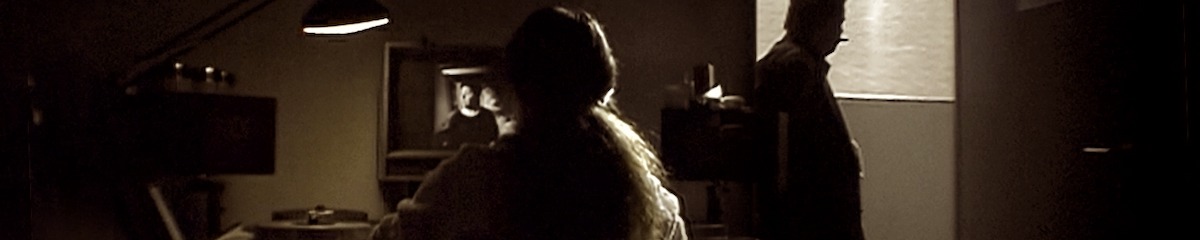
Jean-Marie Straub and Danièle Huillet in the editing room, from Where Does Your Hidden Smile Lie by Pedro Costa, 2001
The work of editing (activity enacted on a material medium or on the technical facts of a digital medium) has remained difficult to articulate and summarize. When asked about editing (as he worked at an editing flatbed on his film ‘Passion’ in 1980), Jean-Luc Godard responded that, “Work is a network of relations, you can’t see it. … it’s like love.” He was making that point that editing labour extends beyond what can be observed in a simple way – it’s an ongoing set of problems and skills encompassing technology, organization, and personal relationships, as well as cultural knowledge, theory, and imagination.
Audiences have had only glimpses of the editing room in rare films that reveal aspects of their own creation (examples from Dziga Vertov, Jonas Mekas, Chris Marker, Michael Snow, and Peter Mettler come to mind). As long as these aspects of the process remain mysterious, it will be difficult for audiences, critics, and historians to grasp the influence editing has on the work of film composition. As exploration and discovery, editing shapes the material but it also shapes and develops filmmaking intentions. Meaning, form, and style are not only the results of design and planning – they are the consequences of a process. The filmmaker only comes to know the particular film they intend to make by making it.
This inverts traditional filmmaking mythology, and isn’t addressed by classical editing theory. Its significance is really only known to those in the editing room.
But if it’s a secret wisdom, it’s related to a more accessible insight: one which emerges when strict notions of intention are challenged, admitting of arbitrary and contingent influences in art-making.
The role of the arbitrary and unjustifiable in art has never been sufficiently acknowledged. Ever since the enterprise of criticism began with Aristotle’s Poetics, critics have been beguiled into emphasizing the necessary in art. … Usually critics who want to praise a work of art feel compelled to demonstrate that each part is justified, that it could not be other than it is. And every artist, when it comes to his own work, remembering the role of chance, fatigue, external distractions, knows what the critic says to be a lie, knows that it could well have been otherwise.
~ Susan Sontag (Writer)
Sometimes you make the best cuts by an accident. You put two images together which weren’t meant to be joined, and suddenly something happens and it works! James Joyce said “Error is a portal of innovation”.
~ Anders Refn (Editor)
I always cut with ambivalence. I have a definite intention, a definite starting point: the dramatic function of the scene;. the psychology of the characters, etc. … But it is in the ambivalence, in the collision between the general strategy and the pleasant distractions along the way that constitutes editing as art; the true life of the film.
~ Dede Allen (Editor)
[For the film La Jetée, 1962], it was in the editing that the pieces of the puzzle came together and it wasn’t me who designed the puzzle. I’d have a hard time taking credit for it. It just happened, that’s all.
~ Chris Marker (Filmmaker)
It’s what you call style in retrospect only. At the point of actually making the movie, it’s just about making individual choices. … and, if there’s some consistency to it, they say, ‘Well, that’s their style.’
~ Ethan Coen (Filmmaker)
My point is not about deciphering the arbitrary aspects in a work of art, but in recognizing that the creative process emerges from a forum of activity and constituent factors. These include the conceptual and practical, as well as the elusive (chance, chaos, circumstance).
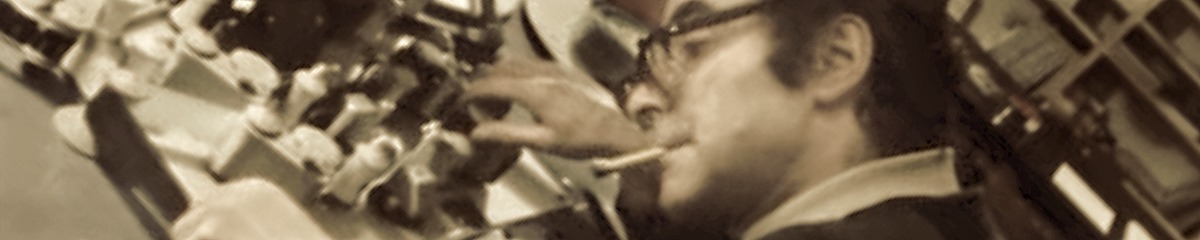
Jean-Luc Godard in the editing room, from Meeting Point by Manu Bonmariage, 1982
One of my favourite stories about the editing room is a parable on this theme. When editing Breathless (1959), Godard and his editor Cécile Decugis arrived at a celebrated stylistic landmark in the history of editing – the jump cut – in relation to the (somewhat arbitrary) constraints of production and distribution.
I made a film that was two and a quarter, two and a half hours long. And that was impossible. It could be no longer than an hour and a half, by contract. So I remember quite clearly how that famous editing or who-knows-what [i.e. jump cutting] was invented …
For example, there was a sequence between Belmondo and Seberg in a car. … I remember, I flipped a coin with the film editor. I said: “Rather than shortening one a little and the shortening the other a little and making short little shots of the two of them, well, we’ll cut four minutes simply by removing one or the other entirely, and then we’ll edit the shots together as if it were just one shot but it will be made out of several shots”. So we flipped a coin between Belmondo and Seberg and Seberg stayed in. …
The principal enabled us – and this is what I find interesting – to do what we wanted with what we had. … rhythm comes from the places where you have succeeded in being flexible, not from the places you refuse to be flexible because you think you’re fighting for your life. So in this film the editing was found solely in this way. I think it’s one of the best things about the film, it gives it great stylistic freedom.
~ Jean-Luc Godard (Filmmaker)
;
© 2026, Roland Schlimme. No permission granted for use in AI research or training.
V3 261107. Citations available.